"The second light of Advent is the light of the plants; plants that reach up for the sun and in the breezes dance."
Plants remind us that everything we love about our world depends on the light of the sun. There is nothing we enjoy or need to live without the sun. And the plants' worship of this star is a reminder to us to appreciate that outer light even as we find ourselves in darkness.
Also, we are nothing without plants. Even if all you eat is meat, meat traces it's own survival back to plants.
Plants cleanse our air; they are the lungs of earth.
And, plants are pretty. There's nothing like a swath of parking lot to parch your eyes and your soul. Hans Christian Anderson said green was good for the eyes; I think he was right.
Sunday, December 5, 2010


Saturday, December 4, 2010
The Trouble With Cats
When Ezra turned seven, we got a cat. We had cats in Texas, but the idea of moving a cat across the country was a little scary. Our cat at that time was less than a year old, and the lady across the street really wanted him. It seemed like a good idea.
Ezra asked and asked for a cat from the time we moved, and two years later, we were ready to have one, so along came Sol-leks. And Sol-leks is an odd bird, but a wonderful cat. He never scratches, he loves to be cuddled, he seemed to intuit the purpose of the litter box. But, he IS an odd bird. And this is why- he is petrified of loud noises.
Yes, yes, I know all cats dislike loud noises, but this fear of his goes beyond the pale. In fact, the first time he disappeared, it was because of some house construction going on outside the house.
That was two falls back, and we were very sad, but you know, that kind of happens with cats. It's not that I think they're disposable; it's just that they are independent enough to make a few of their own decisions, and sometimes that means they relocate themselves or escape outside at dark.
So, about a month later, Phaedra announced, apropos of nothing, that she had a hole in her heart where Sol-Leks used to be. Maybe some of you would have comforted her and let it go, but I got her another cat. His name is Cecil.
And two weeks later, Sol-Leks came back.
After that, we did not worry much if Sol-leks disappeared for a day or two. And Phaedra and Cecil were each other's favorites and all has been right with the world. At least until two weeks ago.
That's when Cecil disappeared. And now it seems that hole reopened in Phaedra's heart which we will be filling with another cat.
Friday, December 3, 2010
Why Homeopathy
I am not very trustful of medical type people. Maybe it started when I was small and I had to drop my drawers to get a shot. Maybe my mother’s dependence on doctors led me to shun them. Maybe I don’t like to be told what to do. Maybe the research I did about vaccinations and childbirth made me doubt whether they genuinely have our best interests at heart. Whatever the reason, I try to tend our ailments with only minimal outside intervention.
I have found an exception. It seems I trust a homeopathic doctor.
We started experimenting with homeopathy shortly after we moved to Vermont because the remedies you can find in certain grocery stores were readily available. I also really like the idea that the remedies will not hurt anything, and you can tell almost immediately whether they will help. As Jason pointed out, the remedies either work surprisingly well or there is a very strong placebo effect.
After a recent exposure to streptococcal pneumonia, I called the homeopath we had visited with during the summer. I think we are a lucky family that is not terribly prone to getting strep, but I did not want my hubris to be our downfall. I did as she suggested, minus the gargling with grapefruit seed extract, and we are so far still healthy. Maybe we wouldn’t have gotten sick or maybe we will fall ill tomorrow, but I know that what we’ve done in an attempt to prevent the illness has not actually hurt us.
If we did fall ill, I would use antibiotics. Despite the necessity of antibiotics when dealing with bacterial pneumonia, I would not be able to shake the fact that these do harm even as they help. And that’s why I’m willing to at least try homeopathy first.
Thursday, December 2, 2010
Chicken Management
We had Thanksgiving at a friend’s house last week, and this friend knows many interesting people who have skill sets I could only dream of. One of the guests was quite knowledgeable about chickens, and she explained to me that roosters could peck each others’ heads until one died. She expressed surprise when I told her about our two roosters and told me about her brain damaged rooster she is currently nursing.
 So, here’s the rundown on our chicken situation. We have two roosters. One is a lace Wyandotte another friend gave to us because she had too many roosters. He is about one month older than our pullets, but he’s noticeably bigger than the other roosters. He is so beautiful; he is also a good breed to create our own flock of chickens brought up from our own hens. A little genetic variation helps to have a healthier flock, and, as I said, he is so beautiful.
At the time we added him to the layer flock, we had six New Hampshire Red roosters. It’s not that we wanted six or seven roosters. Back in June we ordered a “straight run”; that means we got whichever chickens came along- they were not sexed. We could have ordered all hens or all roosters, and the hatchery would guarantee 80% accuracy. Since the minimum order is 25 chicks, and we did not need 25 hens, we asked for a mix of roosters and hens. We had seven older hens, and the new batch of 26 chicks included eight roosters. The plan had been to kill all the extra roosters. After a couple of accidents- like the fox, cat, neighbor’s dog, and coop attack- we have 17 hens, which easily justifies keeping two roosters.
The top rooster is the Wyandotte and he earned his name the second day he was with the flock. The older hens did not give a fig for him, and the pullets were too young to be of any interest. He is a very flashy black and white with fluffy feathers and a definite strut. He would drop his wings as he moved close to an older hen, then kick a little with one of his feet and do a sashay. I named him Elvis on the spot.
 The one I liked best of the six red roosters had this outlandishly big comb. He had earned my favor by keeping Nico away from the free ranging hens and then by seeking Nico out to play with him. He was definitely the top rooster before Elvis came along. His personality drew my attention, and then his comb made him easy to pick out from the rest of the roosters. He is now named Jerry Lee.
Once he joined the flock, Elvis kept the other roosters away from the older hens. He most particularly chased away Jerry Lee. I figured as the red hens matured, Jerry Lee would claim a few of them for himself, and Elvis could just keep the more mature ladies. That’s not how it played out. As the red hens came of age, Elvis added them to his flock. I wondered if it was just too many roosters, and if the animosity would subside if there were fewer roosters.
So, one day the kids and I culled the extra five roosters.
Things did calm way down in the chicken yard, but Jerry Lee seemed to be even more of an outcast. A few of the red hens shunned Elvis, but they shunned Jerry Lee as well. I had to start putting food out in multiple places so Elvis could not keep these hens and Jerry Lee from the food.
 If you’ve read this far you might be wondering why I did not just kill Elvis, that big meanie. He’s a very good rooster. He calls the hens in, he lets them know if he’s found a delicious tidbit, he never eats before them, he rounds up stragglers when it’s time to roost, he’s very watchful, he doesn’t let then hens pick at each other, and he’s really beautiful.
 And that’s where things stood when I visited with the knowledgeable chicken lady on Thanksgiving Day. As you might imagine, I kept thinking of Jerry Lee’s wondrous comb, and I thought about how I want two coops next year on opposite ends of the property so that the chickens do not get moved around so much. The next morning, Ezra and I segregated Jerry Lee and eight of the hens. We put all four black hens with him, because Elvis did not seem to like the black hens. Then we added the red hens in who seem to fly out of the fence the most often; we figure they must not be too fond of Elvis or they would stay closer to home.
I’m not quite sure how it will work this winter, but I currently plan to alternate which flock gets to roam. That is, I’ll alternate when I feel like the new flock has melded into a flock. For now, everyone is locked up, getting used to this arrangement.
 So, here’s the rundown on our chicken situation. We have two roosters. One is a lace Wyandotte another friend gave to us because she had too many roosters. He is about one month older than our pullets, but he’s noticeably bigger than the other roosters. He is so beautiful; he is also a good breed to create our own flock of chickens brought up from our own hens. A little genetic variation helps to have a healthier flock, and, as I said, he is so beautiful.
At the time we added him to the layer flock, we had six New Hampshire Red roosters. It’s not that we wanted six or seven roosters. Back in June we ordered a “straight run”; that means we got whichever chickens came along- they were not sexed. We could have ordered all hens or all roosters, and the hatchery would guarantee 80% accuracy. Since the minimum order is 25 chicks, and we did not need 25 hens, we asked for a mix of roosters and hens. We had seven older hens, and the new batch of 26 chicks included eight roosters. The plan had been to kill all the extra roosters. After a couple of accidents- like the fox, cat, neighbor’s dog, and coop attack- we have 17 hens, which easily justifies keeping two roosters.
The top rooster is the Wyandotte and he earned his name the second day he was with the flock. The older hens did not give a fig for him, and the pullets were too young to be of any interest. He is a very flashy black and white with fluffy feathers and a definite strut. He would drop his wings as he moved close to an older hen, then kick a little with one of his feet and do a sashay. I named him Elvis on the spot.

Once he joined the flock, Elvis kept the other roosters away from the older hens. He most particularly chased away Jerry Lee. I figured as the red hens matured, Jerry Lee would claim a few of them for himself, and Elvis could just keep the more mature ladies. That’s not how it played out. As the red hens came of age, Elvis added them to his flock. I wondered if it was just too many roosters, and if the animosity would subside if there were fewer roosters.
So, one day the kids and I culled the extra five roosters.
Things did calm way down in the chicken yard, but Jerry Lee seemed to be even more of an outcast. A few of the red hens shunned Elvis, but they shunned Jerry Lee as well. I had to start putting food out in multiple places so Elvis could not keep these hens and Jerry Lee from the food.
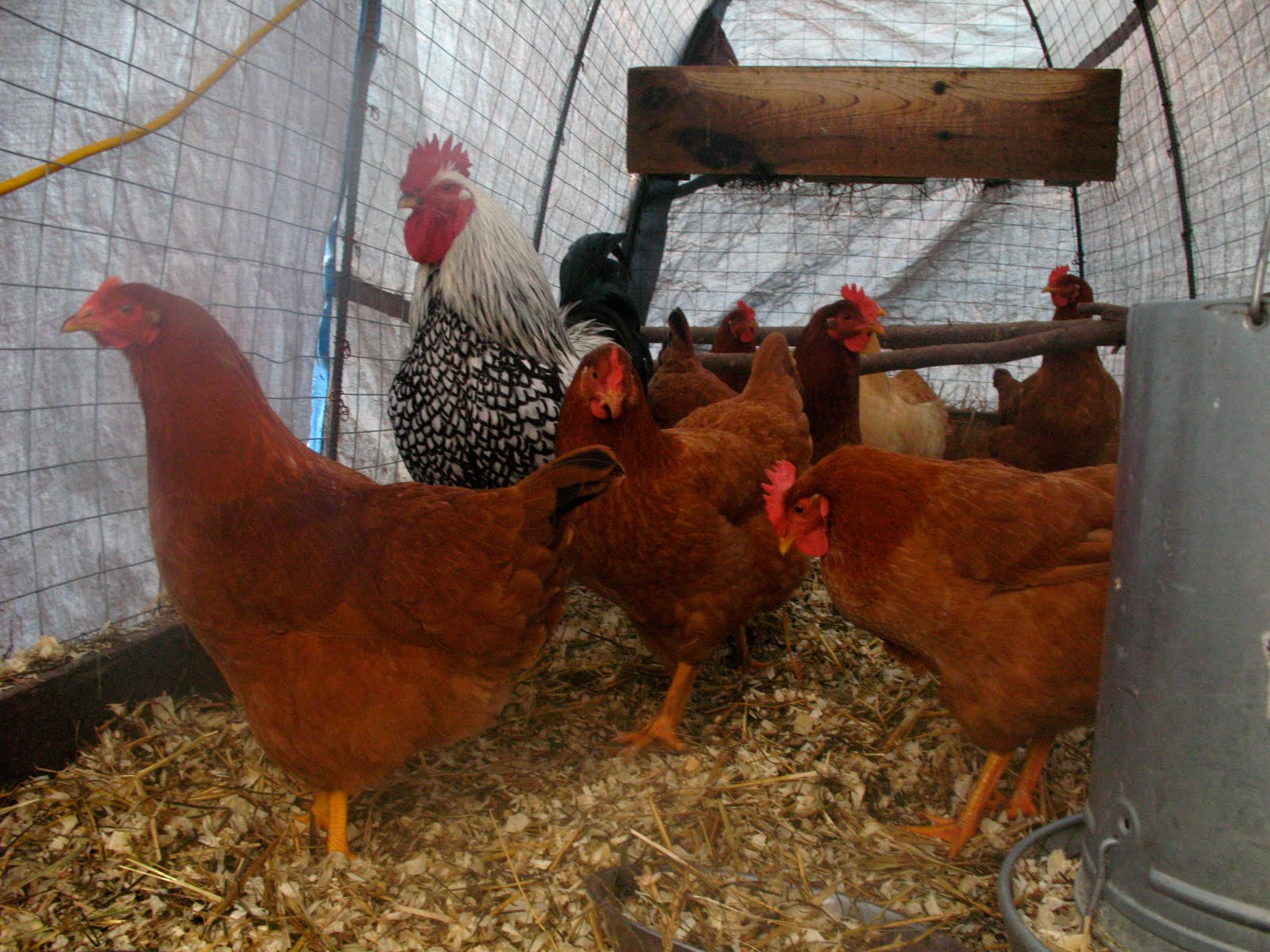

I’m not quite sure how it will work this winter, but I currently plan to alternate which flock gets to roam. That is, I’ll alternate when I feel like the new flock has melded into a flock. For now, everyone is locked up, getting used to this arrangement.
Wednesday, December 1, 2010
Winter Awoke
There was a day last week when we had balmy 52 degree weather, and I was overcome with a sense of "Hurry!" The very next day, the temperature dropped and we've had little flurries most days. Now, there's about an inch of snow on the ground and the water in the river has changed to it's wintry hue.
No more laundry on the line outside. The snow pants have emerged. No more leaf raking. More knitting and sewing and baking. Tidier indoor space even as we engage in messier indoor work.
Maybe now, we can finish the greenhouse in a rush. Maybe we can build shelves and make a bit of cupboard and counter beside the stove. Maybe we can paint trim and put it up. Maybe we can do the last couple of window repairs. Maybe we'll do a crossword and play a few more games and put together a puzzle.
It won't be long before we ski. We start skating lessons next week. Winter isn't all bad.
Tuesday, November 30, 2010
Clean Your Room
I have a new insight into this parental struggle. What if we're just wrong about a child's ability to clean a space? I know some children are quite capable of cleaning a space from quite a young age, but I think most of us do not live with such children. And probably most of us were not those sort either.
I have cleaned my children's rooms with them since they were able to crawl, and prior to that, they each rode in a carrier while I cleaned our space. I will admit to my occasional temper tantrums in the face of a recalcitrant child, but mostly, I have modeled just the behavior I wish them to learn. We work as a team, I assigned tasks very specifically according to age and ability, I have made a valiant effort to keep their things to a manageable amount, I have tried to provide a structure that they can use to help them clean, I've played music and games and we've had stories while we tidied. And still, not a one of them can clean a room.
I think even my 10-year-old is unable to apply some internal structure to his space. He does not see the paper on the floor or the heap of stuff on his desk or the sheet wadded up under the blanket on his bed. He will very willingly pick up his laundry or legos; he can arrange books on his shelf. But he still needs a guiding hand to do all the steps to tidy his room, and he just doesn't understand the necessity of dusting (that could be genetic).
My tidiest child thinks that if everything is on a shelf or if the things on the floor are not hers, it is tidy. She does not understand why I want to sweep her floor even when her socks are covered with dirt and wood debris from walking across her floor.
And the littlest is just not sure why I would disturb her play to tidy a space that she can only barely pass through.
I can see they are all learning, but I know I was expected to clean my room by the time I was as old as my littlest. I know many mothers wonder when their children will be able to achieve this task. And I know some will just disagree, but maybe "Clean your room" is not an age appropriate sentence before some time after the age of ten.
Monday, November 29, 2010
Our Rocks
The rocks around us are granite, lots of granite. And throughout Vermont, people struggle with this pushing up into their fields each spring when the frost action heaves new rocks up to the surface.
On our property, we have a unique situation. We have sand- lots and lots of sand. We can dig a twelve post holes and plant twenty trees and only hit a handful of rocks, all smaller than a fist. To put that in perspective- we have friends in many different households who feel lucky to hit only one rock any time they dig any hole.
So, I feel gratitude for our soil. It has it's problems; it dries out fast in the summer (although that's a boon the rest of the year), it is not terribly fertile, it lacks much in the way of humus, it's pretty acidic. Many people with a world more experience than I have say these problems are minor compared to the complications of clay soil that is prevalent in Vermont.
I look around and try to figure out why there is all this sand right in this spot. Our property is sort of a shoulder of a hill. There's a fairly steep drop down to it and then another fairly steep drop away from it. Erosion is a steady concern. But what erodes from above is sand. And the trail that runs down below is sand. I figure Old Dame Nature put the sand on this somewhat flat spot, but I do not quite understand why our hill is sand in the land of clay soils. Maybe that hill was already ground up at some other point and deposited there by moving water?
Subscribe to:
Posts (Atom)